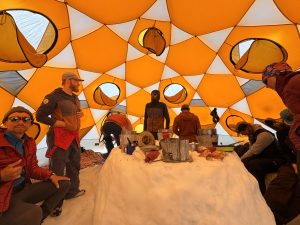

Ever wondered what it’s like to raft the Copper River with SEAG? Read this trip report to be transported into the world of Alaskan rafting and get motivated for your next trip.
Standing on the shore where the Copper River meets the Chitina, one feels as though they have been transported out to sea. Seagulls screech among the crows and ravens and bald eagles, fish guts flow like beards down their faces. The wind whips sand into eyes and down throats, white caps ruffle the top of the muddy confluence. An eclectic collection of fisher people, rafters, tourists, and wildlife congregate on the shores– on a busy day the muddy river bank is crowded with boats and anyone responsible for a rubber raft or a fishing child must take extra care to ensure the two parties never meet. The confluence is both an economic and ecological hub, with salmon swimming at the heart. It is also where St Elias Alpine Guides begins our Copper River rafting trip.
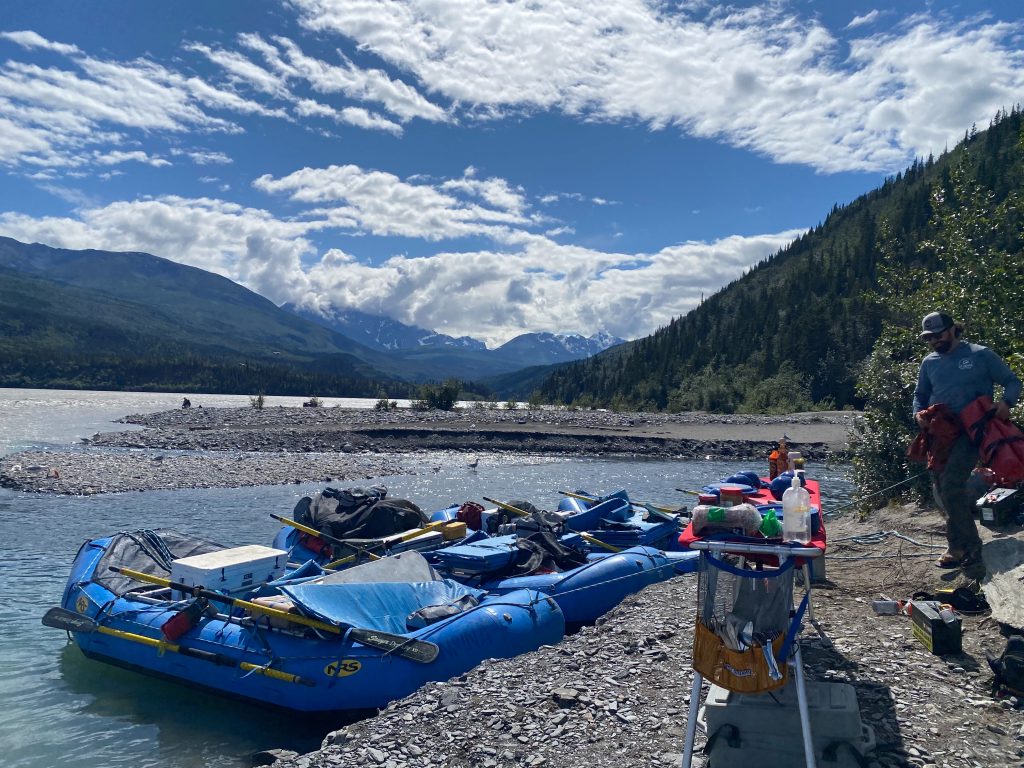
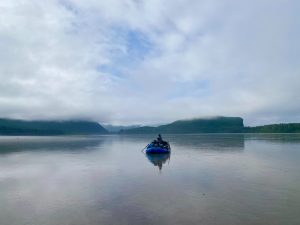
When our party of four guides arrived at the O’Brien Creek boat ramp in Chitina, I was green to the world of commercial river guiding. The Copper was both my classroom and my testing grounds. The eight day trip would take us through the heart of the Chugach Mountains from Chitina to Cordova, on a river that moves more silt in a day than the Mississippi might move in a year. After gearing up our boats [coolers, repair kits, tables, partner stove, fuel, dutch ovens, tents, spare oars, wag bags, groover, 16 folding chairs…] we met the 12 clients we were to row down the river and geared up some more [rain boots, frog toggs, sun hats, gloves, snacks, sleeping gear, guide books, toiletries, extra salt, thermoses…] made lunch, and pushed off.
To travel down a river is first and foremost to surrender personal power to the water, and secondly to recognize that there is no going back. Once in the current there is no way to propel a heavily loaded boat back up stream, and so rowers and passengers alike enter into an unspoken contract. The only direction to go is downstream, and everyone aboard must be prepared to undertake the journey forward. With this in mind, there is an unmatched tranquility that comes with down river travel. Unlike trekking or climbing in the high mountains, one never has to consider whether it is wise to keep going or whether a party should bail and turn around. By eliminating the choice to stop, rivers force us to entertain a sort of peace that I have yet to encounter in any other activity. There is a reason the most laid back individuals are labeled as “go with the flow,” and to experience this mentality in the most literal sense is both a liberating and exhilarating event. As we entered the main current of the Copper and my only sun hat was snatched instantly off my head and carried out of sight by the wind, I could feel the quiet acceptance of river time kicking in.
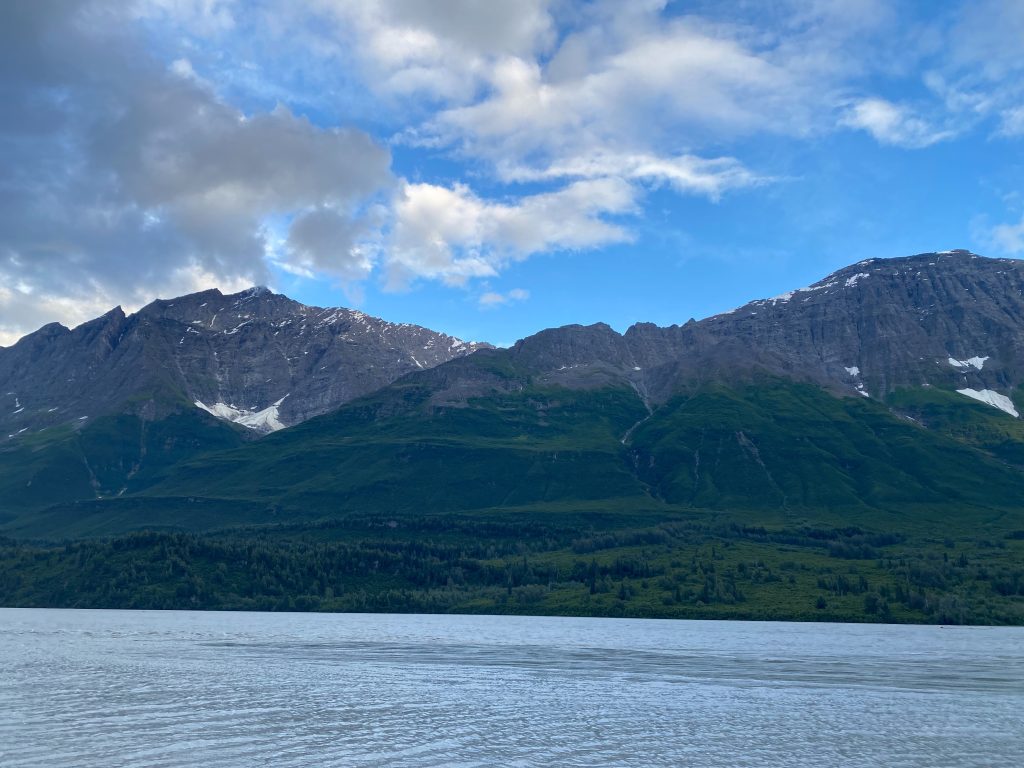
Day One on the Copper is long on the prep and short on the water. A tight gorge marks the entrance to the Chugach, with boils and eddies forming in water the color of chocolate milk. The river feels powerful here, constricted as it is between tight canyon walls. Snow covered peaks appear and begin to glow pink as our party pulls off for dinner. Camp is established on a muddy river bar, dinner is cooked and served in caste iron pots, beers are passed around, and our Client Liaison (Jeff) provides an overview of life in camp for the next week. Groover protocol is particularly emphasized, as it should be on any good river trip.
Day Two, as with every day, begins early for us guides. Cody is our coffee master, and spends the better part of our breakfast prep time as a chemist in a lab working to determine the correct ratios of water to coffee to temp to time. The result is a pot of coffee as black as jet fuel, and a crew of guides that are well caffeinated for the day. Rob and I work on breakfast as clients wake up. We make hashbrowns and eggs and bacon and toast on big skillets, taking turns at the partner stove. Once everyone is up and full, camp breakdown begins and we are off. The river twists and turns, we talk about the hydro mechanics of boils that race up from the depths and erupt near and far from our boats. We watch for bald eagles, for bears, and for bison as the river propels us ever downstream.
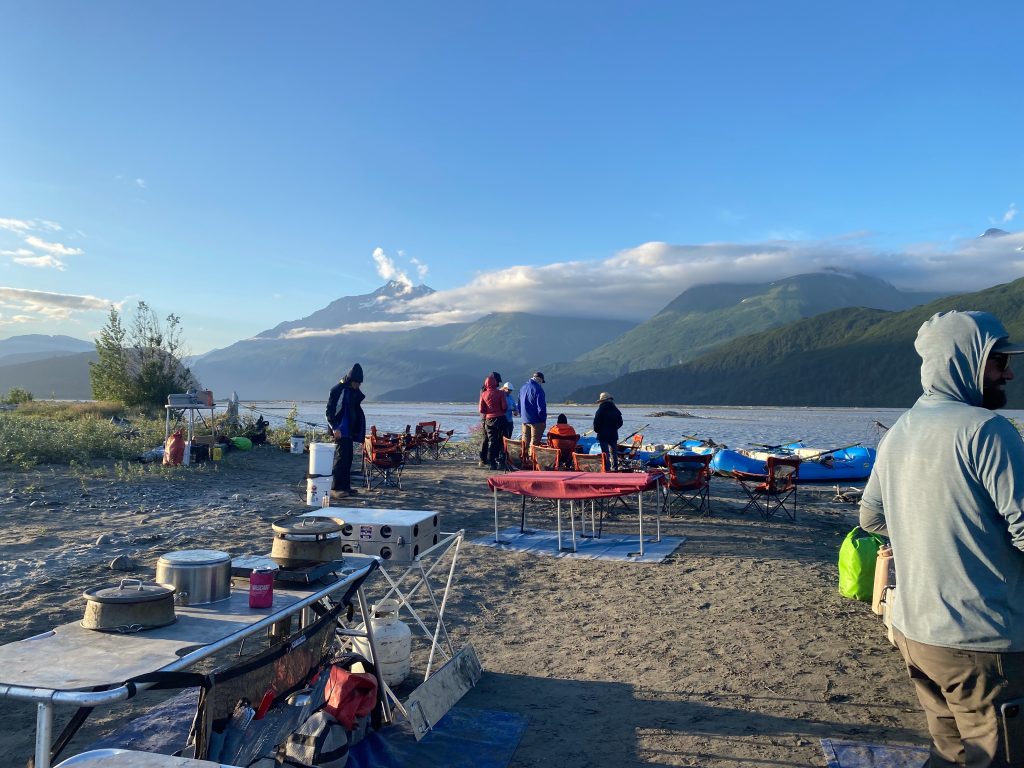
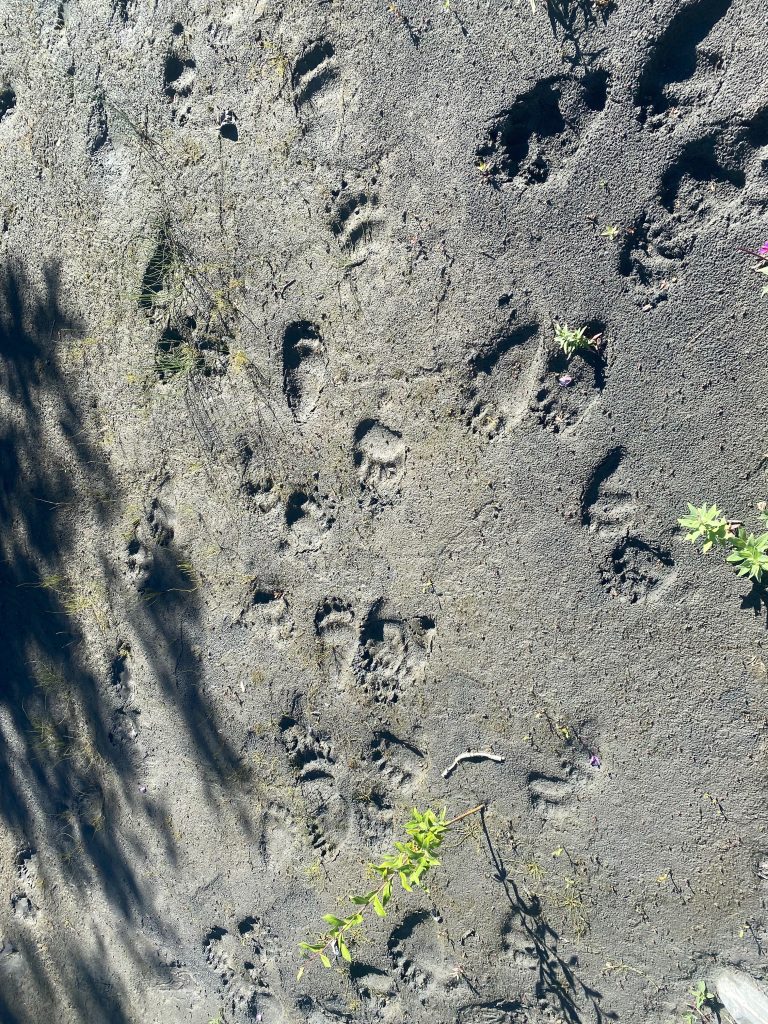
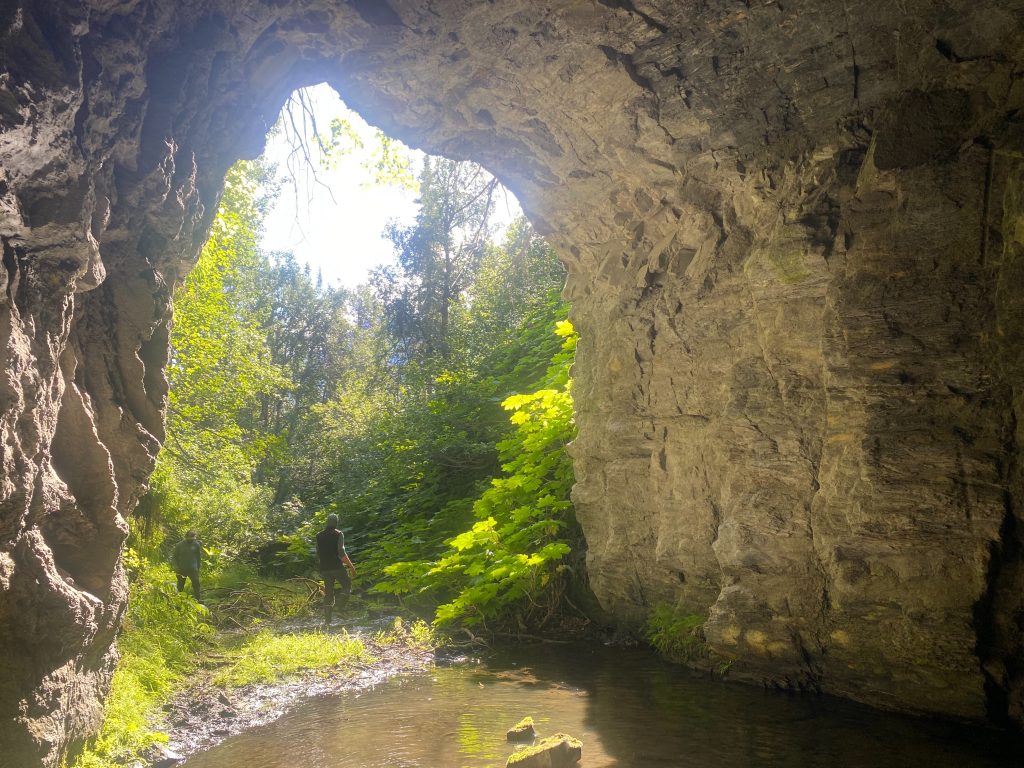
The currents in the Copper river are powerful– to maneuver a boat along them takes both endless patience and sharp attention. The wind blows up river or across, depending on its mood, and it becomes a game of angles and geometry to keep a heavily loaded craft in the main channel. For a passenger, the views are spectacular. The Chugach range is displayed in a gradient from emerald green along the river banks to white and black on the snowcapped peaks. We stop to walk along the old railroad bed, leftover from the Copper River Northwestern Railroad that transported copper from our home in Kennicott all the way to the port of Cordova. Walking along the banks in search of long forgotten railroad tunnels, we are surrounded by horsetails rising to our waists and cow parsnip in bloom that towers so high it seems to be a relic from a prehistoric age. Light filters through a canopy of aspen and birch and alder. The bird song is raucous and incessant, and we frequently pause to stand in silence so that we might identify the endless singers. We float, we make camp, we grill shrimp tacos and flip pancakes, we drink dark coffee and ice cold water filtered from creeks that run into the river. One evening, a curious bear is spotted patrolling the groover area and we put down our dinners to follow its tracks until they disappear into the brush. Our first several days on the river come and go.
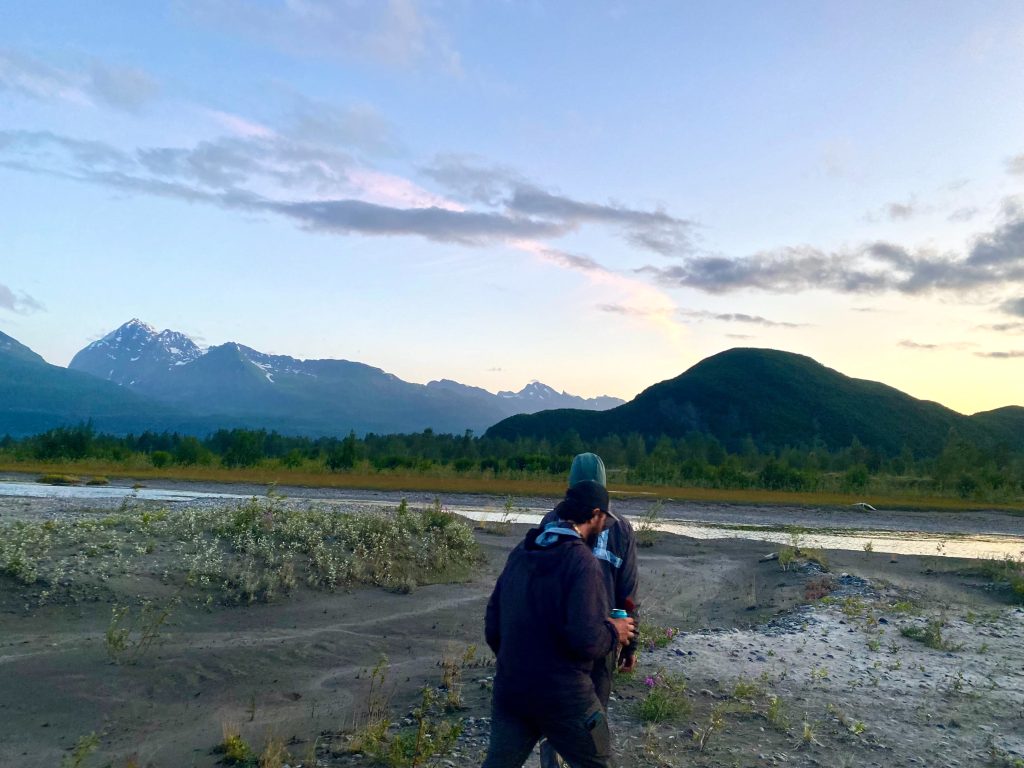
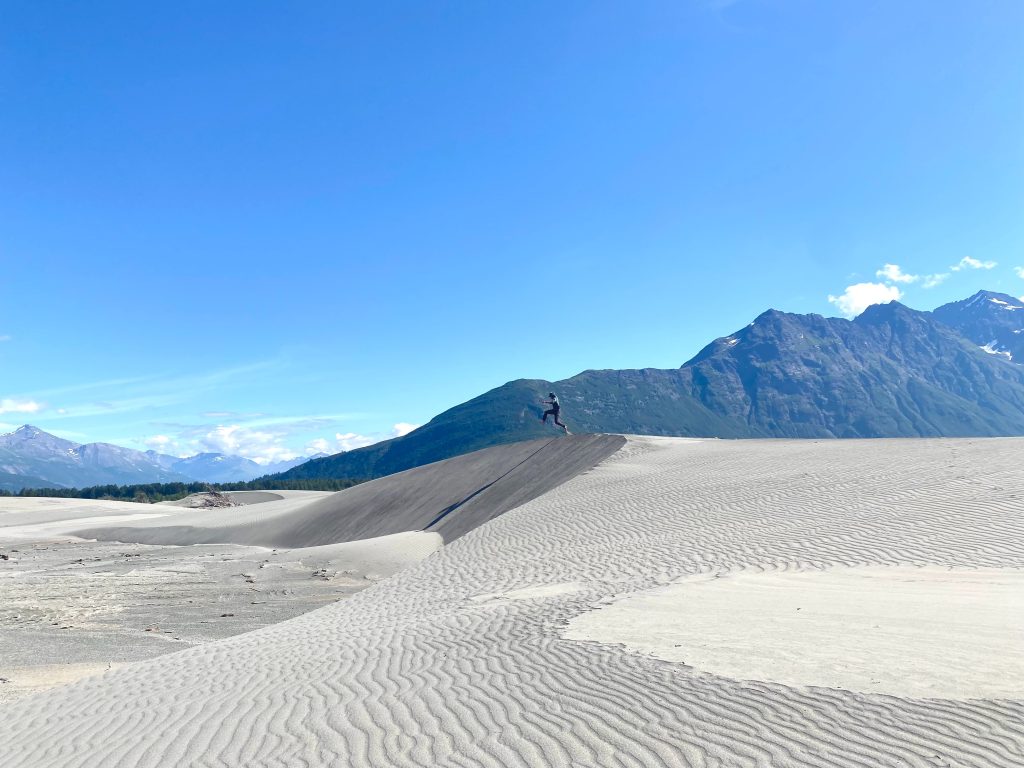
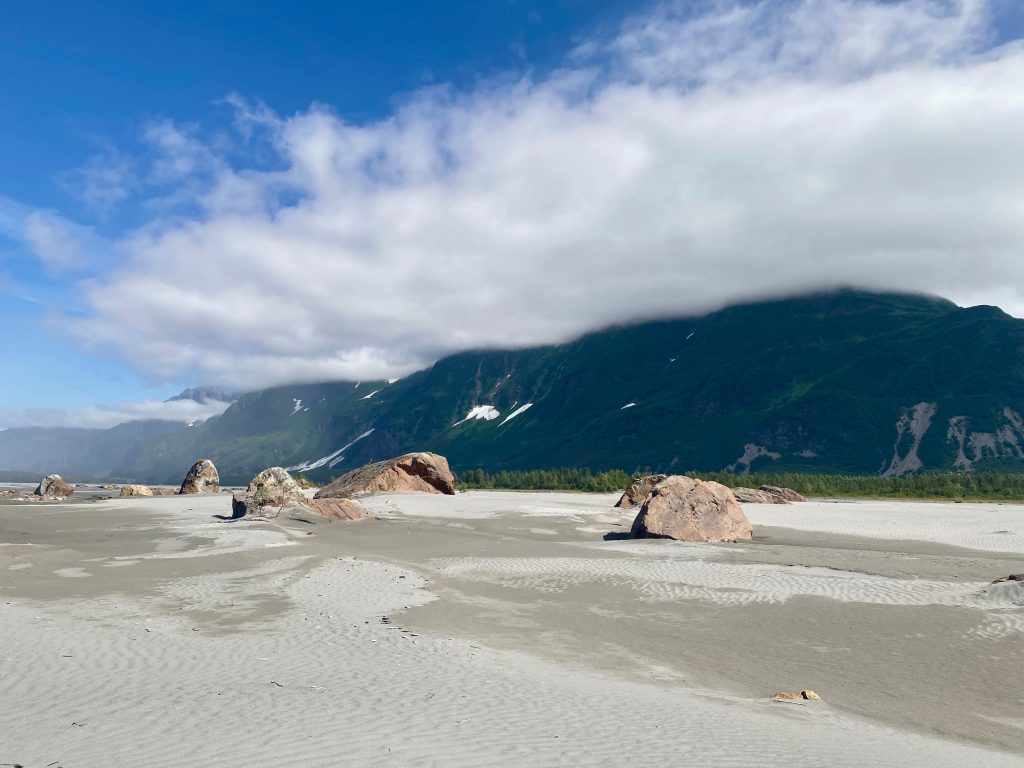
Finally, we reach the Bremner dunes. Deposited silt from the Bremner glacier stretches for miles alongside the river, the dream of any four wheeler enthusiast from the lower 48, yet entirely unoccupied due to their remote location and therefore free and peaceful for us river runners to explore. Rob and Cody try backflips and front flips down the steep sand, I marvel at the glittering particles stuck to my bare toes. We live in fear of jinxing the good weather we’ve experienced thus far, and the sun bakes our shoulders. Jeff takes a nap on the raft. The Dunes mark the beginning of the second half of our river trip, and a transition in landscape from trees and tall peaks to the world of glaciers. The wind has been known to pick up here, blowing silt every which way, and we work hard to ferry our boats across eddie lines and around sand bars back to the main current.
Now, our path is marked by sweeping landscapes and sand. We watch a pair of bears lope along shore where we’ve just pushed off from lunch. They seem to relish in the expansive beach, the end of which is marked by ice bergs the size of houses that float lazily across Miles Lake. Miles Lake forms at the base of Miles Glacier, which we can see rising out of the water in the distance. Huge chunks of ice break from the face and float downstream with us– we call these “non-stationary river obstacles” and our course changes in accordance with the movement of the ice. We watch huge bergs rock and flip and feel the wake left by their constant motion lap at our boats. We are infinitely small in this land of giants.
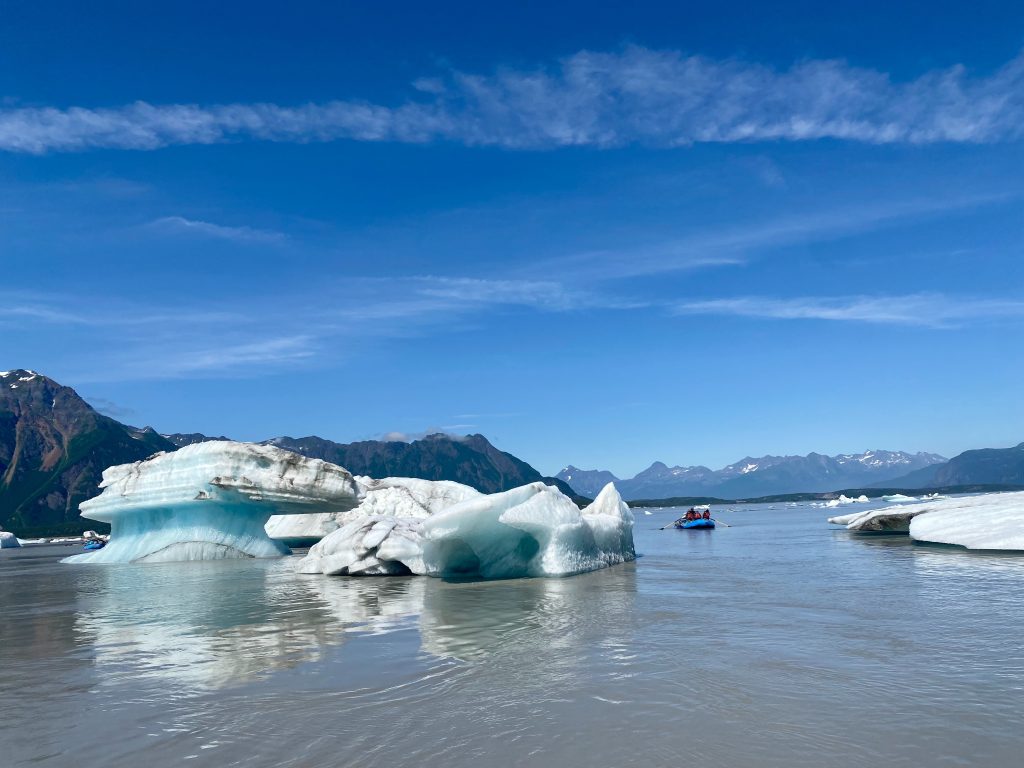
After hours of marveling in quiet awe at our new river companions, we set out to wrassle a berg. Ice bergs are small at the surface, but extend deep under water and are able to harness the energy of the main current far below what our oars can reach. We use ropes and carabiners to put a sling around an iceberg and then tie our boats together into a raft. After some maneuvering, we find ourselves being pulled along at almost 6 mph, much faster than our usual 3-4. We put down the oars and relax to enjoy the view. Berg wrasseling was a success. Our berg steers us in a trusted line across Miles Lake and down river, where the outline of the Million Dollar Bridge is coming into view.
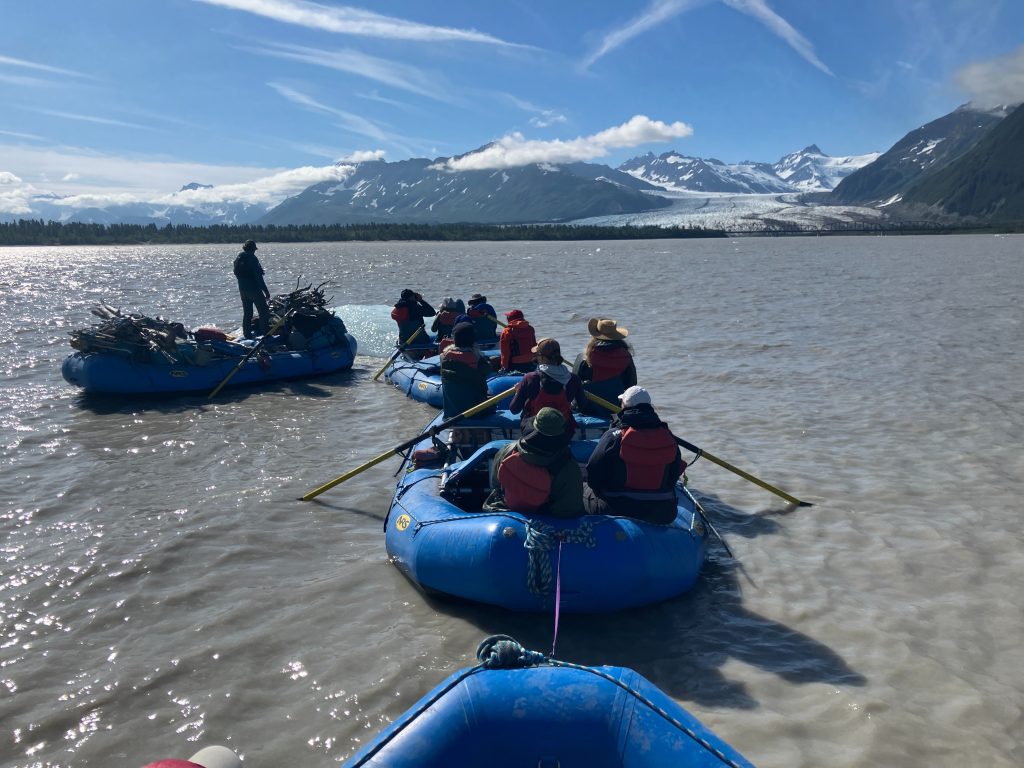
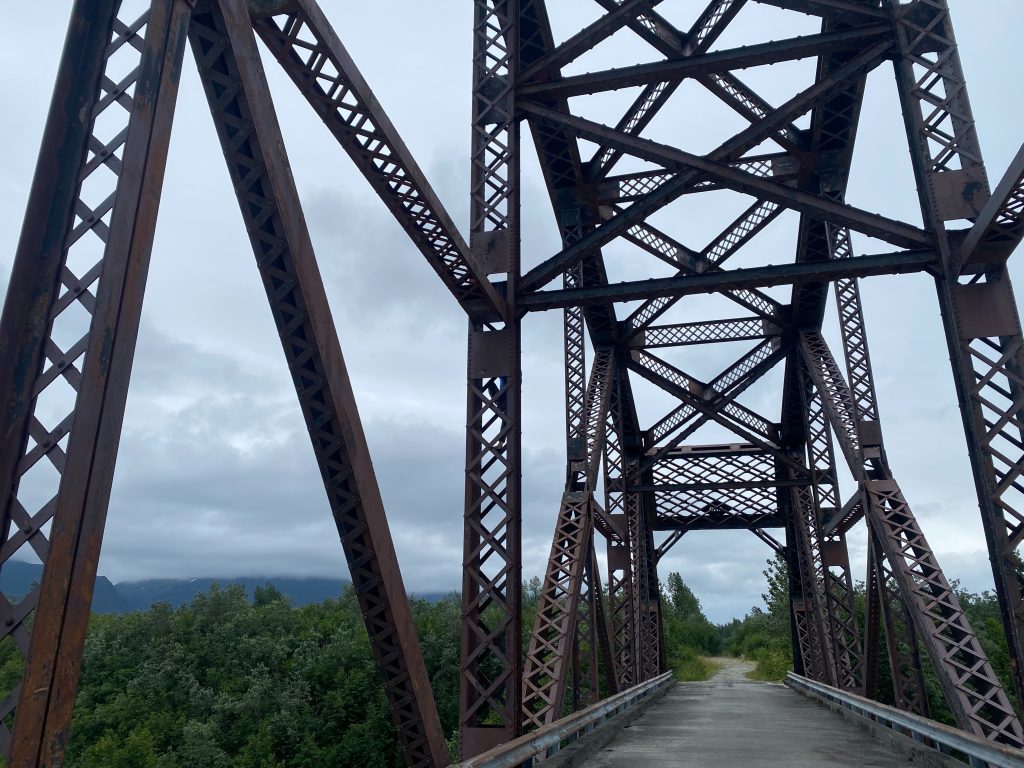
As its name suggests, the Million Dollar Bridge was one of the more costly sections of the Copper River Northwestern Railroad (CRNW, also known as “Can’t Run, Never Will). Big Mike Heney was the engineer that ultimately pulled off this feat, completing the 196 mile stretch of railroad that connected Kennicott to Cordova in 1910. With the Miles Glacier coming in upriver from river left and the Childs Glacier downriver on river right, the MDB was necessary to avoid putting railroad tracks directly across either actively calving glacier. Huge berg breakers span each pylon, and the bridge stretches over 1500 feet across the river. We ditch our berg tow to navigate the pylons, and pull into the Childs Glacier Recreation Area. A sound like a bomb exploding punctuates our arrival to camp as a chunk of ice the size of an apartment building calves from the face of the glacier and shatters in the river below.
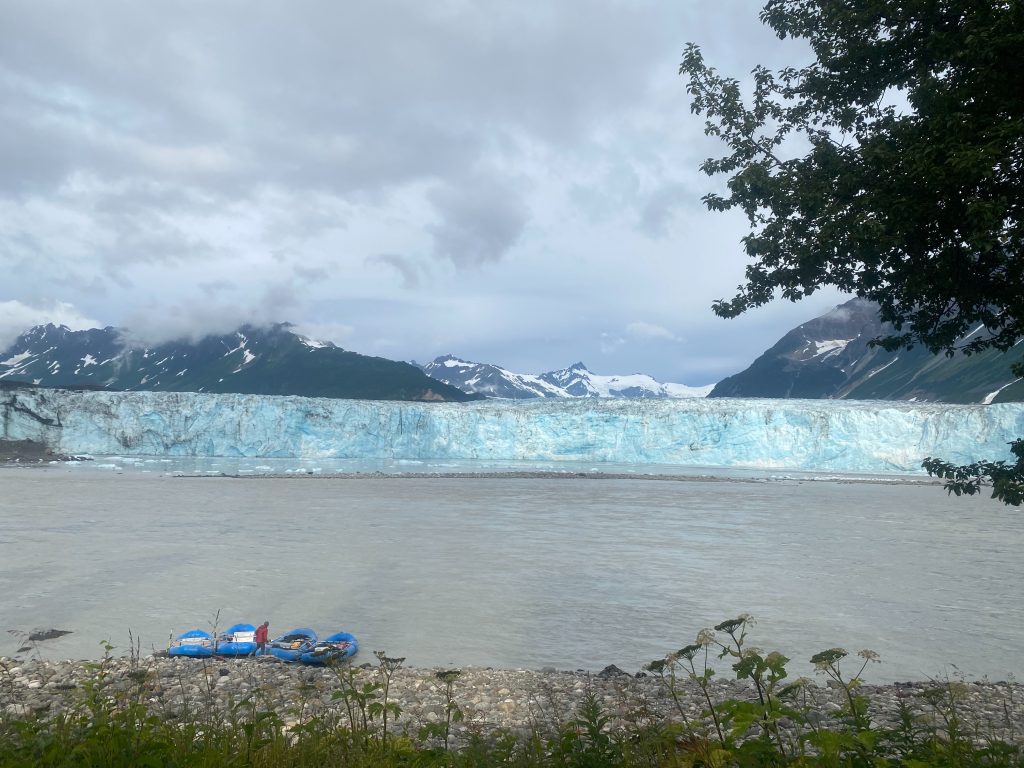
The Childs Glacier is the most actively calving glacier on earth, with pieces falling off roughly every 15 minutes. We will stay across the river from this masterpiece for two nights, setting up our kitchen and chairs to watch the show. Rob and I make Copper River salmon for dinner, Jeff sets up a margarita bar. Cody preps coals for dutch oven pineapple upside down cake. We label the chunks falling into the river based on where they come from, and their size. There’s the lower and upper deckys, corresponding to the top or bottom half of the glacial face. There’s the super bowl, where ice has carved out an enormous bowl shape on the downstream side of the face. Finally, there’s the elusive double decky, in which an entire section, top to bottom, collapses into the river all at once. Jeff pulls out a guitar, and we are hard pressed to move from our viewing positions. In the night we hear the consistent glacial crashes, and in the morning we take turns poking our heads out of the tent to report on massive calving before it’s time to get up and start coffee once again.
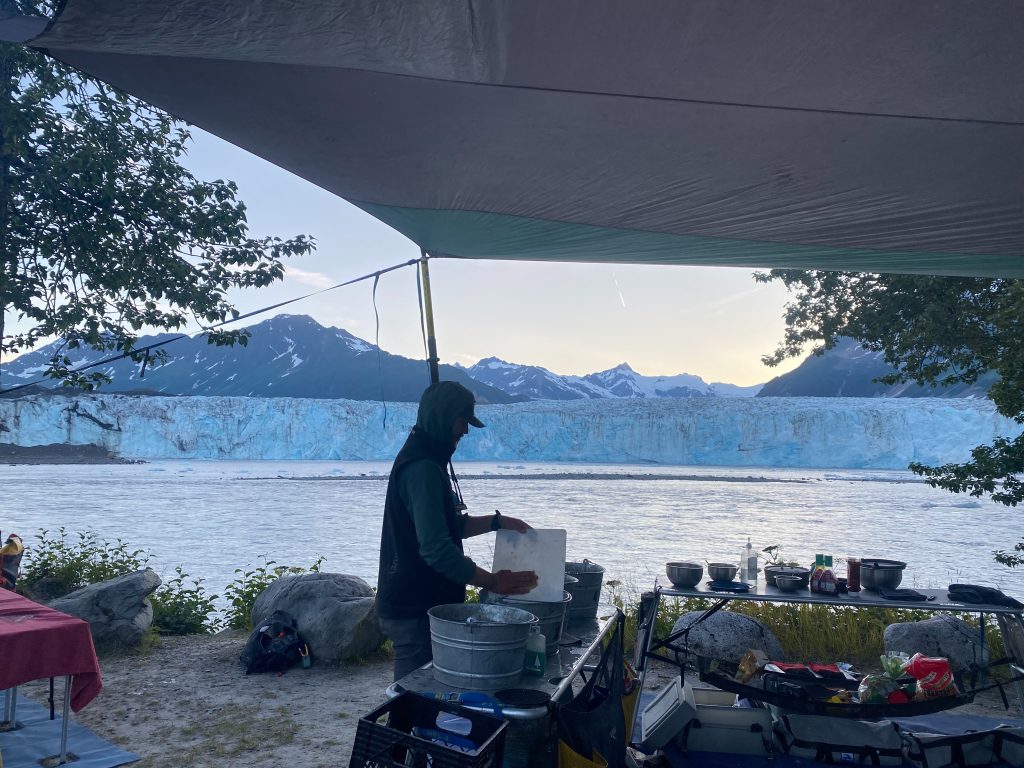
Our layover day is passed with an exploration of the Million Dollar Bridge and a hike to view the river valley from above. The fireweed is in full bloom and we discuss the salmon migration up the river as well as the impossibilities of bridge building that were made possible and are demonstrated in the bridge under our feet. Rob climbs a trestle and perches like a crow high in a nest. The next morning, we experience the reality of every Alaskan river trip and it rains while we pack up camp and float down the river. Today, we began to see seals, marking our proximity to the coast and the end of our journey.
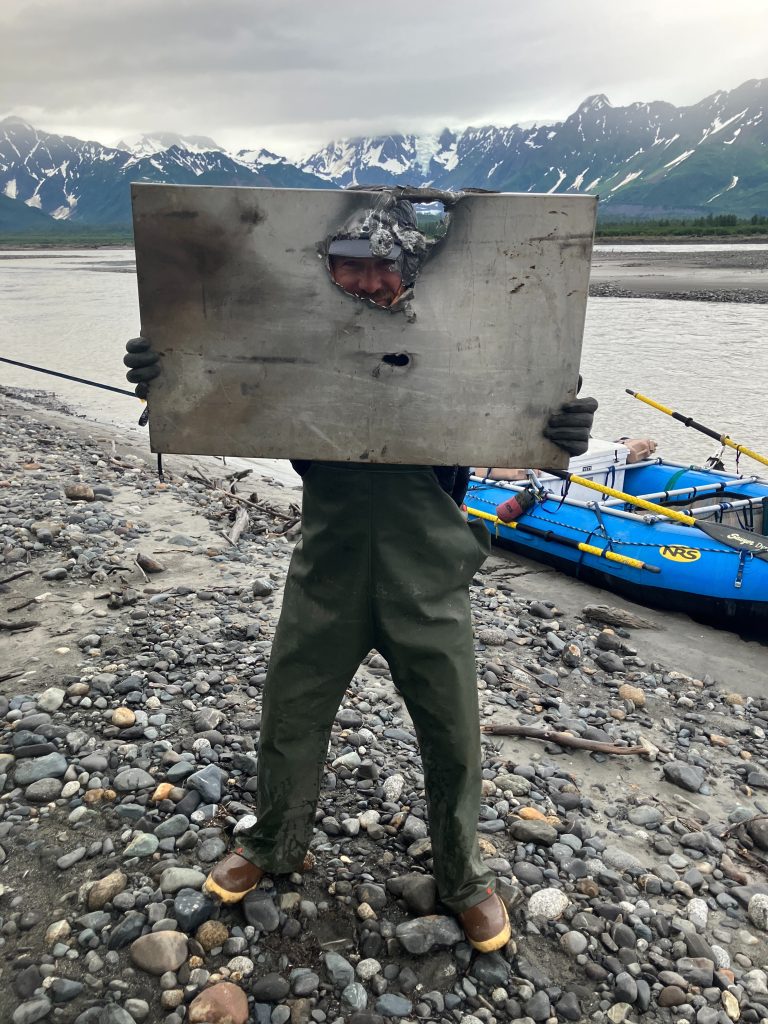
The salmon are so numerous in the Copper River, that seals have been known to swim with their eyes closed while they hunt. They simply move through the water until they bump into a fish, and then enjoy their dinner blind. They follow our boats, hoping for scraps, and we pull into an eddy to watch yet another bear poking for fish in a side creek. Eagles remain abundant and become even more so as we approach Cordova. For our final night we share a small island with the seals and the eagles, although we find no bears. It rains, and we build a raging fire on the beach, melting the lid of our fire pan in our efforts. Well worth it to keep us warm while protecting the ecosystem of the river in the meantime. Our final day is bitter sweet. We navigate tiny braids in an effort to stick close to the right shore for our takeout. I get my boat stuck and it takes two of us pushing with all our might to move it off the gravel bar and into the current. We occasionally separate, with two boats taking one braid and two taking another, racing to see who will arrive first at the place where the river reconnects. The river at this point resembles a massive tidal flat, and is in reality, the beginnings of an enormous delta. When we finally reach our takeout in Cordova, we make lunch and begin to break down gear. It is difficult to soak in the majesty of the trip while working hard and fast to deflate boats and load trailers, but even still the water moves ever forward in the background, carrying on all the way to the sea.
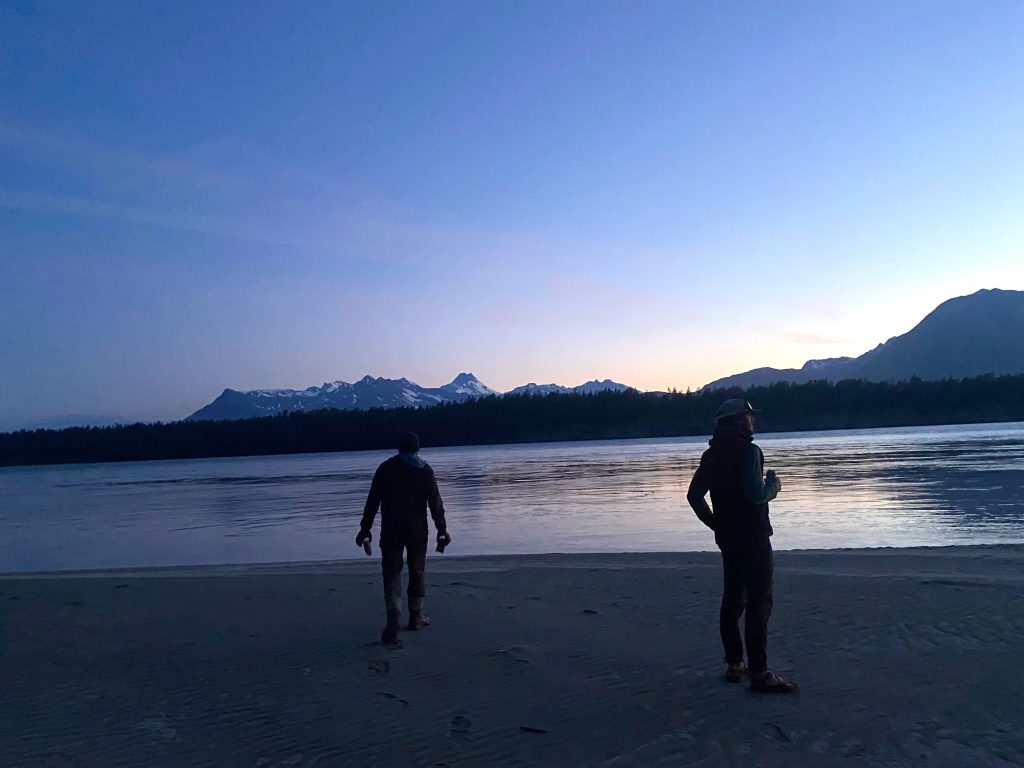
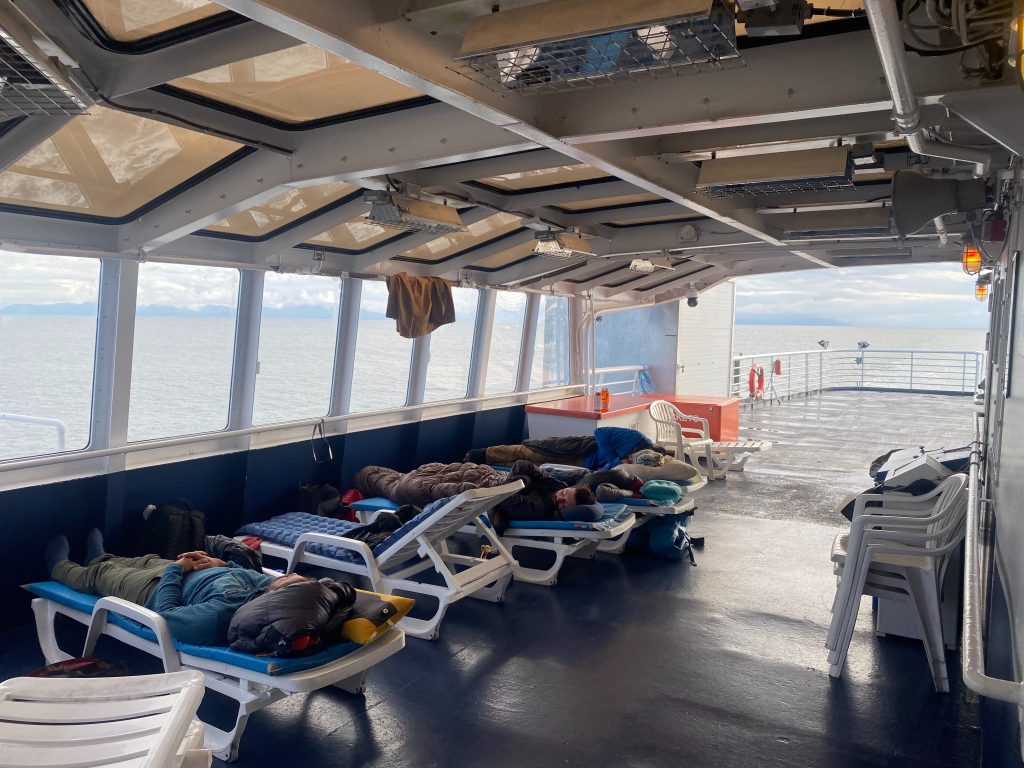
We have one final dinner together, all 16 of our crew, at the Orca Lodge in Cordova. We see salmon flopping around in the shallow intertidal zones and the air smells like creosote and rotting salmon berries. The rain is only fitting here, where every element of life is dependent entirely on the water. Our clients will fly out of the Cordova airport in the morning, and we will board a ferry that will take us 12 hours through fjords and coves all the way to Valdez. We will nap under the solarium and watch for whales, then drive the 6 hours home. On the McCarthy road around 2 am, the northern lights dance over our familiar skyline.
Written by Stella Jorgensen