
MT. BEAR
EXPEDITION
Multi Day

- Mountaineering
- Ski
MT. SANFORD EXPEDITION
- Expert
- Mountaineering
- Ski
- Multi-Day
Step up to Alaska’s high-elevation terrain
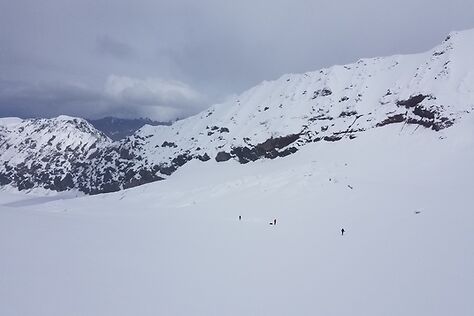
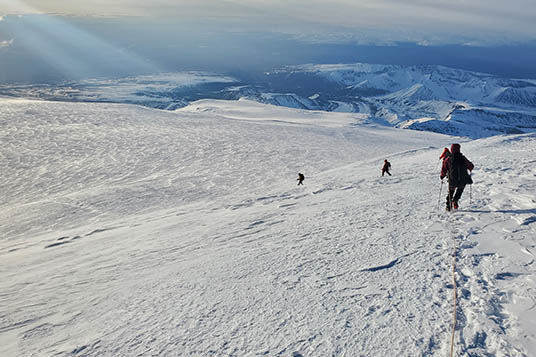
Mt. Sanford (16,390′) combines all the elements of a serious Alaskan expedition—huge glaciers, wild weather, and true remoteness—while remaining surprisingly accessible. For mountaineers seeking their first high-altitude objective or ski mountaineers eyeing a legendary 10,000’ descent, Sanford is an ideal choice. The ascent is straightforward, but the experience is massive. Guided expeditions are all-inclusive and have the best chance for a safe and successful adventure.
- 3rd-tallest volcano and 6th-highest peak in the US
- Invaluable high-altitude experience
- Opportunities to learn about big-mountain expeditions
- Epic ski-mountaineering objective
- Stunning views of the Wrangell Volcanic Field
- Easy and quick logistics in the Western Wrangells
Trip Details
Elevation
16,237′
Expedition Length
13 days in Alaska
10 days on the mountain
Total Milage
22mi
Total Elevation Gain/Loss
11,000′
Max Group Size:
6
Difficulty:
Alaska Grade 2
2027 Rates:
Private Solo
$22,750
Private 2 Participants
$12,680/person
Private 3-4 Participants
$9,100/person
Private 5-8 Participants
$7,450/person soon!
Dates:
Group Trip:
April 25 – May 7, 2027
We guarantee the 3-4 Participant Rate for our Group Trip, even if fewer than 4 people sign up.
If more than 4 people sign up, we will lower the rate accordingly so you get the best deal!
Private Trips with custom dates may be available. Schedule a call with our Expedition Coordinator to plan your Private Trip today!
The following is a sample itinerary for this trip. Due to individual abilities and goals, as well as the strong environment swings of Alaska, all of our trips are customized as they unfold. Your guide will fluidly make decisions based on weather, conditions, logistics, safety, and group dynamics to maximize each day’s experience. There can be quite a bit of variation, but we always strive to make every trip your best ever!
May 19th
May 20th
May 21st
May 21st
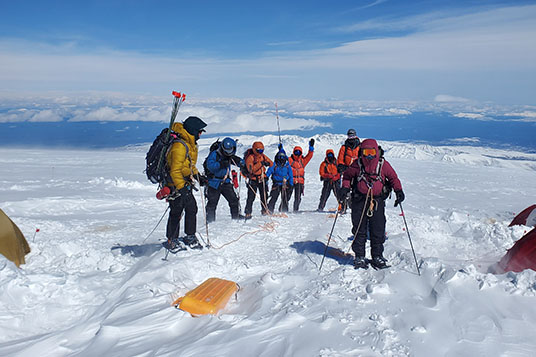
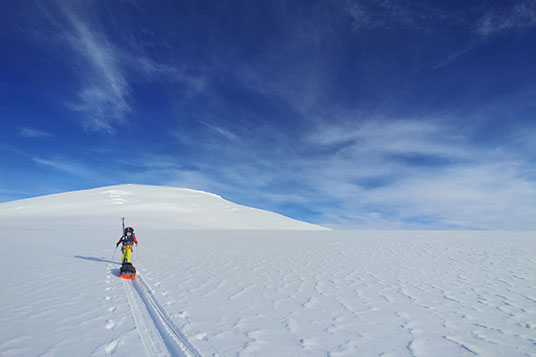
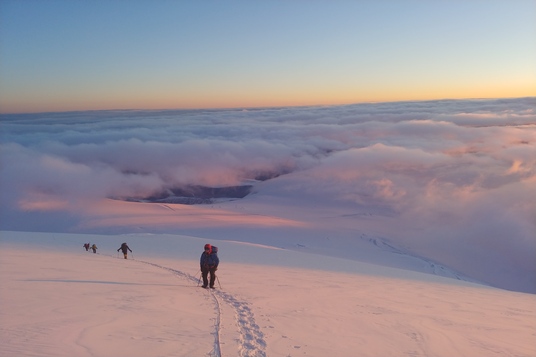
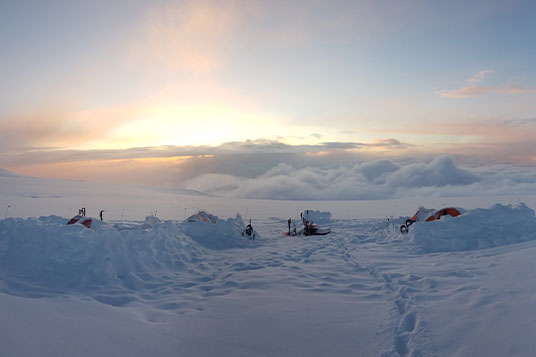
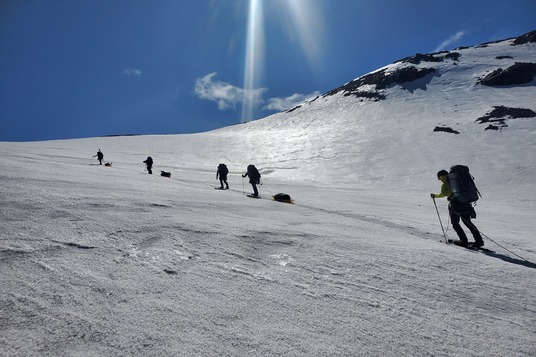
Fly 20 miles Southeast to the lower Sheep Glacier and begin your approach to the magnificent Mt. Sanford! Depending on conditions, you may be lucky enough to start your ascent from the just barely unfrozen tundra. Today you’ll get acquainted with the weight of your pack as you get carry a load or two to the glacier and distribute your gear amongst your sleds, rope up, and start heading up to set up your base camp.
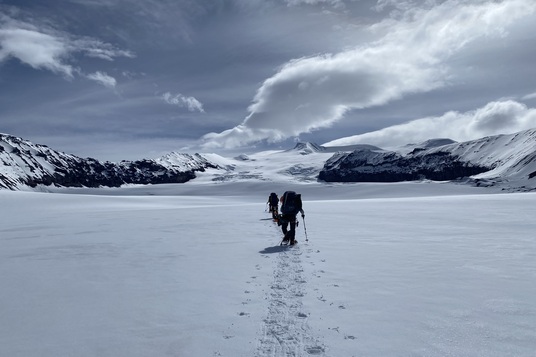
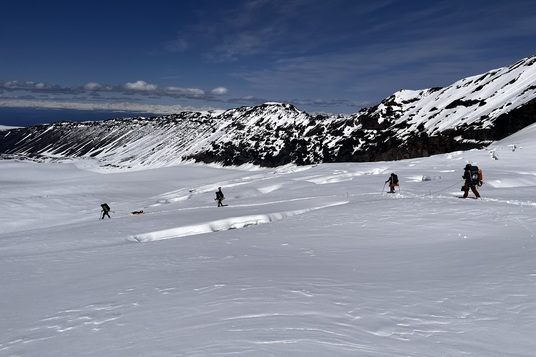
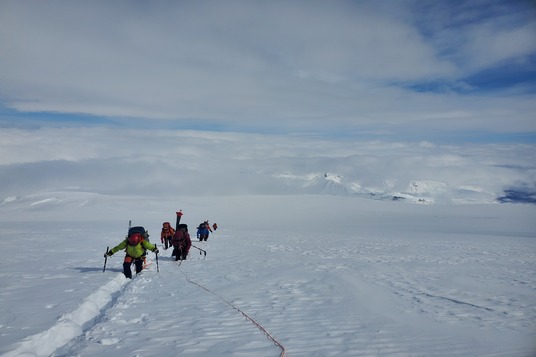
Making your way up the towering giant, you’ll navigate giant crevasse fields and a tricky icefall as you make your way up the glacial ramp. Shuttling gear and sleeping low will provide time for acclimatization and skiers the opportunity to enjoy some wide open turns. After the summit bid is made, you’ll reverse your route and make your way back to the landing zone. Acclimatization and weather will likely dictate your pace, your guides knowing when to take the opportunity to push and when to wait it out.
Complete your climb with 360 views from the summit of the tremendous volcanic massif before you begin to reverse the route. If you’re on skis, we cannot emphasize enough the glory of this ~10,000′ descent!
May 30th
May 31st
- Customized trip planning
- Van transportation to and from Anchorage*
- Three nights at a local lodge before and after the expedition (Glennallen area)
- Two 45min scenic bush flights to and from the Mt. Sanford
- A comprehensive orientation and group packing day ahead of the expedition
- Your professional guides (1:2-3 ratio)
- All the food on the expedition and at the lodge
- Group gear (ropes, sleds, cookware, fuel, tents, etc)
*Upgrades to bush plane transport may be available.
We highly recommend you bring as much of your own technical equipment as possible so you can learn how to use it and become more familiar with it.
What’s not included?
- Gratuities
- Personal camping and technical gear
- Lodging and logistics in Anchorage
- Trip insurance (required)
Easy peasy! This expedition is an all-inclusive package. You just get yourself to Anchorage, and we’ll take it from there!
We’ll pick you up in Anchorage and drive you (about 4hrs) to a cozy local lodge on the Western edge of WSENP. Food is included and provided by your guides while in front country and out in the backcountry. The next day we’ll run a comprehensive orientation and group pack day where your guides will make sure you have everything you need for the trip ahead.
The next day, Day 3, you’ll fly out to the base of the mountain to begin your approach. Flights are always weather-dependent so stay flexible. We fly in small planes to access tricky landing zones so your team will fly out in a series of flights, each 30-40min one way. Upon landing, you’ll begin the ascent – good luck and god speed!
After a successful summit and descent, you’ll make your way down the mountain, arriving back at the LZ. Our trusty pilot will shuttle the team back to the Glennallen area and you’ll enjoy a final night together at the cozy lodge.
On the final day, we’ll provide van transportation back to Anchorage. You should plan on arriving in Anchorage around 3-4pm. The driver can drop you off anywhere in central Anchorage.
Upgrades to flights between Anchorage and Glennallen may be available. Please let us know if you’re interested.
The more climbing experience you have prior to climbing Mt. Sanford, the more comfortable and safe you will be, and the better chance you will have of summiting. This is an advanced climb that requires a dedicated training regime. The mountain is too severe to be learning certain skills for the first time. The following is required of every climber:
- Excellent fitness, core strength, and endurance
- All climbers are required to submit a climbing resume
- One or more mountaineering climbs that required roped glacier travel, winter snow camping, and the use of an ice axe and crampons
- Some examples include: Mt. Rainier, Mt. Shasta, Mt. Hood, Mt. Baker, Mt. Shuksan, Mt. Adams, Pico de Orizaba, Cayambe, Cotopaxi, or Chimborazo
- Skiers and splitboarders must:
- be very comfortable with off-piste terrain and black diamond-level resort runs
- comfortably ski/ride down 30 degree slopes with a 40lb pack
- have a minimum of 30 days of backcountry skiing/splitboarding, but more is highly recommended
Graduates of our Introduction to Alaska Mountaineering Course are perfectly set up for this expedition
GALLERY

GET IN TOUCH
WITH AN EXPEDITION
COORDINATOR!
FAQ
Some of our mountaineering and ski expeditions, especially the objective-based trips, require participants to submit a climbing resume. A climbing resume lists out your relevant outdoor and climbing experience. We use these to get to know you a little better and to make sure you are signing up on a trip of an appropriate level for everyone’s safety and enjoyment.
This does not have to be a formal document with fancy letterhead, there is no particular format to follow and as long as the info is there, you can email this to us at any time. You can include mountaineering expeditions, rock climbs, ice climbs, alpine climbs, scrambles, and traverses – you can definitely include attempts that didn’t quite make it, but please make that clear in your notes and why. The important details to include about each outing are the name of the area or mountain, the route name, the difficulty rating, the month and year you did it, and your role on the team (was it a solo attempt, where you guided by a professional, were you guiding a group of friends?). You may choose to include other details about your climbs like the distance or elevation gained, how the climb felt to you (was it super easy or were you at your limit?), or anything remarkable that happened during the outing. It can also be helpful to know a little about your general fitness and outdoor experience so you can include information on your workout habits or other relevant athletic feats (extended backpacking trips you’ve been on or how many miles you run a week, for example).
We will review your resume and may have follow-up questions and from there we’ll be able to advise you as to which expedition is best for you!
We pride ourselves on cooking healthy and delicious meals even under the most adverse conditions! Your guide will create a custom menu based on the length and logistics of your trip, and the dietary preferences/restrictions you list in your Trip Application. All our guides are well-trained backcountry chefs and use time-tested recipes from our proprietary cookbook for their trips. We carry a plentiful and varied stock of ingredients and most meals are prepared from scratch (allowing for easy substitutions, additions or subtractions of ingredients). We only use pre-packed freeze-dried meals on summit pushes on our mountaineering expeditions.
On our backpacking and base camp trips, you can expect 3 meals a day, plus snacks of your choice. Breakfasts and dinners are usually hot meals and lunches are served cold. On mountaineering trips lunches consist of a variety of snacks as it can be hard to organize group meals while on a rope team.
We use a combination of fresh, dehydrated, and freeze-dried ingredients to make our delicious meals, however on longer backpacking and mountaineering trips your guides will use more freeze-dried foods than fresh foods to keep pack weights as low as possible.
On our rafting trips, we cook full multi-course meals with fresh ingredients and enjoy hot and cold breakfasts, cold lunches and hot dinners.
Meals for most trips start with Lunch on the first day and end with Lunch on the last day. *
*If you are signed up for a Custom Trip Package with us, it may include more meals. Check with us if you’re not sure. Mountaineering trips also include meals in McCarthy before and after the backcountry expedition.
Likely, at some point or another, at least a little bit, yes.
On a Rafting Trip, you can help the guides unload the boats, set up camp, and carry your dry bags to your tent nearby. After breakfast, you can help take down camp and load up the boats.
On a Base Camp Trip, you will need to carry your gear about 5-20min from the backcountry airstrip to where you plan to set up your camp. You'll carry your gear once at the beginning of the trip and then pack it up and carry it back to the airstrip at the end. Throughout the trip you will hike with a small day pack – this is usually 5-15lbs.
On a Mini-Backpacking Trip you will carry all your gear between the airstrip and your camp, which will be 1-3mi away. This means at least 2 one-way trips with the big backpack (usually 35-45lbs). After setting up camp you will enjoy day-hikes with a much lighter day pack (usually 5-15lbs).
On a Backpacking Trip, you will move camp every night and will need to carry everything you need with you throughout each day. For a trip up to 4 days in length, you can expect packs in the 35-45lb range and for trips in the 6-8 day range, please be prepared for weights closer to 45-55lbs. The burly gear that is required for the Alaskan backcountry isn’t very light so forget “ultralight” and think heavy-duty!
For all Base Camping and Backpacking Trips, the pack weight will really depend on what you bring, so we do recommend having a minimalist mindset. In addition to your own gear, we will be giving you a bear canister full of food and supplies, potentially another item like a fuel canister or a stove, and maybe a part of a tent if you’re not bringing your own (we recommend sharing tents to save weight). Your guides are weight-conscious packers and will never burden you unnecessarily. It’s likely that over the course of the trip you’ll be able to start adding your own things into the bear canister and your pack should get lighter as you eat your food and use supplies.
On our objective-based Mountaineering Expeditions, you will be required to carry all your own gear and some group gear between camps. Depending on the terrain, you may bring sleds with you for all or some of the route. Depending on the route, you may do stretches of the route multiple times, caching gear as you go, so you may not always have the full weight of all your equipment with you at all times. At maximum, you can expect weights of 80-160lbs to be split between a backpack and a sled and at minimum a 30lb bag for single-day excursions.
